SHARED SPACES, SHARED LIVES: ARIANA VAETH’S “EXPANSION PACK” COMES TO CAESTECKER GALLERY
Posted October 14, 2026


Tori, the poison dart frog, in its tank located in the Franzen Science Center.
Imagine living in a 10-gallon tank filled with tropical plants, rock formations, damp soil and a humid atmosphere. It may not sound appealing to humans, but for a poison dart frog, it’s perfect.
Meet Ripon College’s newest residents, Tori and Deb, who are dyeing dart frogs. Their names are derived from the scientific name, Dendrobates tinctorius “azureus.” This frog species is known for its vibrant blue skin, which makes it easier to spot them in the tank located on the second floor of the Franzen Science Center. Deb, the younger of the two, has a lot of growing to do to match Tori’s size.
Ripon has been acquainted with poison dart frogs since the fall of 2020, when Jordan Brawner ’22 discussed with Professor of Biology Memuna Khan the idea of introducing frogs as a “cool factor” and pet to the biology department.
Brawner’s passion for animals was fostered by his father, who raised various creatures and worked at a zoo. His dad’s “basement full of wonders” significantly influenced his love for animals and biology.
“All of my life I’ve been around animals and taking care of animals,” Brawner said. “If you can think of an animal, I’ve probably had it at some point.”
When Brawner started college, his dad was especially interested in poison dart frogs and bioactive terrariums. He had a whole room in their house dedicated to keeping his frogs that were actively reproducing.
When it came time to manage the surplus of eggs, they thought the College would be interested in a donation. Brawner took it upon himself to care for the frogs on campus and trained Khan in their care.
Even though the original frogs from the Brawner family have died, Tori and Deb continue their legacy by reestablishing the presence of frogs in the department.
“The frogs have been used for an annual animal behavior study on amphibians and animal diversity in demonstrations,” Khan said. “One of the interesting things about frogs is that they are really highly adapted for their lifestyle. They’re visual hunters, so you have to feed them live food.”
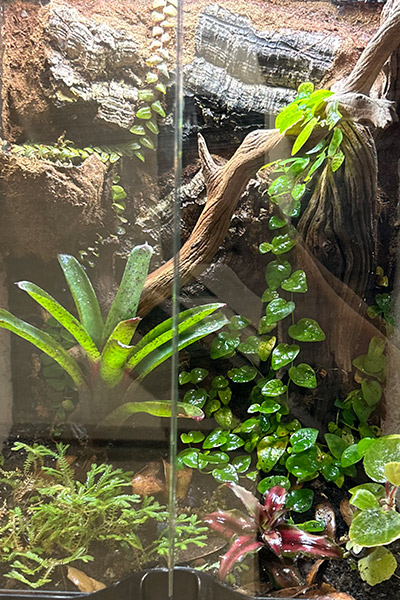
Example of the 10 Gallon tropical habitat.
Poison dart frogs react to movement, which triggers their feeding instinct. To accommodate this, Khan breeds flightless fruit flies, dusted with calcium powder. These specially bred flies make feeding much simpler.
A common misconception is that Tori and Deb are poisonous. Poison dart frogs get their toxicity from the food they consume in the wild, but this pair are captive-bred and have never had access to the food that would make them poisonous. In their natural habitat, the frogs’ bright colors serve as a warning to potential predators.
Khan said Tori and Deb have become a highlight during admission tours, and some Ripon staff and community members have even brought in their children to see them.
“Biology is about life, so it’s nice to have a living representative in addition to the plants in the greenhouse,” Khan said. “I think they’re beautiful — like little gems.”
Brawner, a biology major, currently works as a contractor for S.C. Johnson in their insectary, taking care of the bugs they produce for testing products like Off and Raid.
“I’d like to thank Ripon College for the opportunity to give some exposure to the frogs and the biology department, which hopefully encourages students to visit the frogs and check out the awesome new science building,” Brawner said.
Be sure to stop by to observe these unique creatures up close.