SHARED SPACES, SHARED LIVES: ARIANA VAETH’S “EXPANSION PACK” COMES TO CAESTECKER GALLERY
Posted October 14, 2026


Myat Thinzar Aung ’16 was selected as one of two recipients of the D.C. Spriestersbach Dissertation Prize for excellence in doctoral research for her study of sensory experiences in ancient Roman villas.
Her dissertation originated from a digital reconstruction project during her master’s studies at the University of Iowa, where she recreated the garden and fountain at Villa San Marco in Italy. This work led to field research at the villa, forming the basis for her qualifying paper and dissertation.
“I used 3D modeling to reconstruct and interpret how elements like light, water and vegetation interacted with art and architecture in these spaces at different times of day and year to create such experiences,” Aung said. “I wanted and have been able to make ancient spaces more accessible and relatable to the modern audience through my dissertation because ultimately, my research is about connecting with the human side of history and showing how ancient design still resonates with how we think about space and experiences today.”
She began writing her dissertation when her home country, Burma (now called Myanmar), entered a period of armed conflict and civic unrest in February 2021. This prevented her from returning home or conducting further field research in Italy due to travel restrictions.
“Winning the dissertation prize was both a recognition of my research and the hard work I put in during a difficult time,” Aung said. “It was a validation and encouragement that I needed as I continue building my academic career.”
Aung was one of two recipients of the award. She and the other recipient became the University of Iowa’s Graduate College nominees for the national competition for the Council of Graduate Schools/University Microfilms International Distinguished Dissertation Award.
After earning her master’s in 2018 and doctorate in 2024 in art history from the University of Iowa, Aung became a professor of instruction in art history and criticism at the University of Texas at San Antonio.
“I love working with students and helping them think critically about how art can be contextualized through senses beyond sight,” Aung said. “The opportunity to teach, research and innovate in a supportive and intellectually curious environment has been quite fulfilling.”
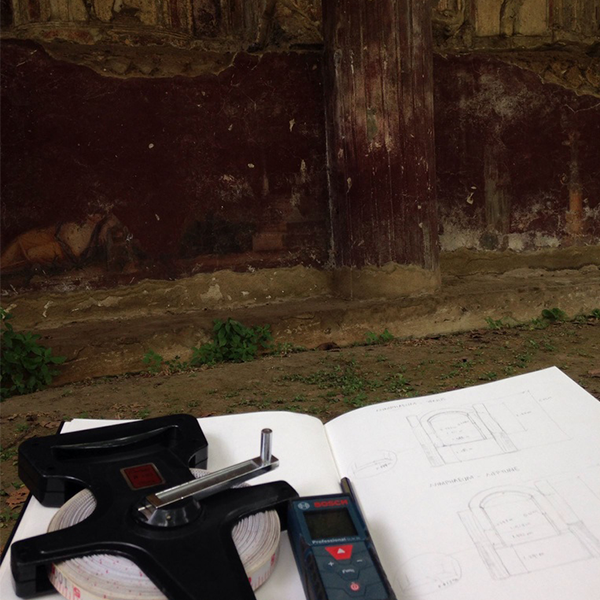
Aung’s sketch, tools and part of the fountain at the Villa San Marco. Photo provided by Aung to University of Iowa.
At Ripon, Aung double majored in art history and classical studies (self-designed). She participated in the Cultural Diversity Club, the Laurel Society and Phi Beta Kappa. She also had jobs on campus, including working at the front desk and archives of Lane Library, holding an assistantship in the art department and art gallery and tutoring.
Aung said Ripon was where she first discovered her passion for Roman art history. She said a number of experiences played a big role in her pursuit of an academic career, citing: a semester abroad in London and Florence, presenting at the National Conference on Undergraduate Research and winning a research award at the Senior Showcase, among others.
“I realized during my time at Ripon that I had both the passion and the aptitude for academic research,” Aung said. “The success I earned gave me the confidence to pursue graduate study and continue developing as a scholar. But above all, it was the close-knit academic environment that fostered my intellectual curiosity and value of professional relationships in academia.”
Aung said her advisers, Professor of Art and Chair of the Department Travis Nygard and Professor Emeritus of Classical Studies Eddie Lowry, supported her academic interests from the start.
“[Nygard] was the reason I majored in art history,” Aung said. “He helped me build a strong research profile and encouraged me to explore graduate programs at Big Ten universities, one of which was the University of Iowa. Now, as an art history professor, I often find myself drawing on Travis’s pedagogical approaches in my own classes.”
Nygard said he recalls how interesting her papers were, specifically her analysis of William Blake’s illustrations for Dante’s Inferno, which she presented at the National Conference of Undergraduate Research and at Ripon College’s Senior Showcase.
“I am thrilled to learn that Myat is being honored for the high quality of her dissertation, but given how insightful her work always was as a student, I cannot say that I am surprised,” Nygard said. “One of the most satisfying things about being a professor is seeing your students go on to do fascinating things after graduation.”
Aung said she is grateful that she majored in art history and classical studies at Ripon because she learned how to understand humanity and the cultural interconnections in history.
“In today’s world, where visual media is everywhere, and with the rise of AI-manipulated images, the skills I have learned as an art history student gave me necessary tools to question what I see and to engage responsibly with the visual culture that surrounds us every day,” Aung said.