Lori Stich
Posted September 28, 2026


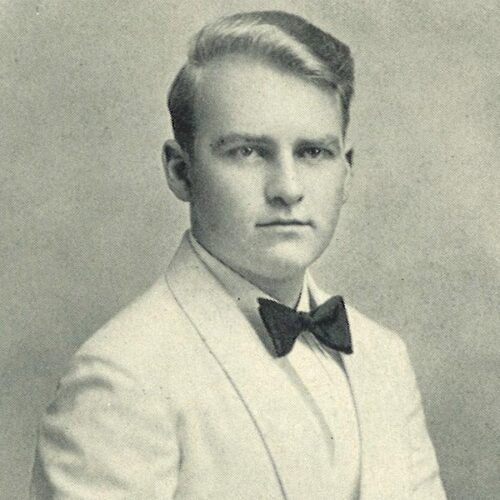
Class of 1936: War correspondent
Allan Andrew Michie was a foreign correspondent, magazine editor, educational publisher and author of numerous best-selling wartime books.
He was born July 4, 1915, in the village of Bankhead, a suburb of Aberdeen, Scotland, and came to Menasha, Wisconsin, with his family at the age of 10. At Ripon, he majored in history and English, was vice president of the freshman class and a speech assistant, participated in debate, extemporaneous speaking, band, College Days, International Relations Club, varsity orchestra, Lambda Delta Alpha and prom committee, and was prom king in 1935.
Immediately after graduation, he joined the foreign affairs staff of Time magazine in New York. In 1939, he published his first book, “Dixie Demagogues,” co-written with Ripon College colleague Frank Ryhlick, Class of 1936. He anticipated that war in Europe was near, so when the book was completed on Aug. 24, he sailed for England the next day. He arrived Sept. 3, 1939 — the first day of World War II.
“The British promptly arrested me when they read through the files of newspaper clippings and notes I was carrying,” he wrote to Ripon. “It took two days before Edward Murrow of CBS and some of his colleagues obtained my release.”
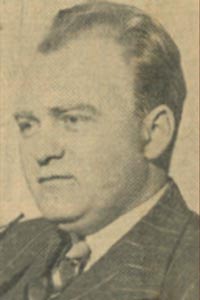 As a war correspondent for the London bureau of Time and Life magazines, then Fortune and later The Reader’s Digest, Michie covered war around the world — the Battle of Britain, the Blitz, Africa, the Middle East, Far East and India. After a “devious sneak crossing of the Pacific,” his boat arrived in Hawaii on Dec. 17, 1941 — just 10 days after the Pearl Harbor attack — and was one of the first newspapermen allowed to see the destruction.
In the spring of 1942, he spent a month in Ripon where he wrote “Retreat to Victory” about his full circle around the world at war. He had traveled close to 100,000 miles, flown the Atlantic five times and visited at least 25 countries. His coverage documented the war in the air and the developing strategy of Gen. Dwight Eisenhower and his commanders that led to the momentous D-Day events of June 6, 1944.
“Anti-climax of the war for me was my ‘capture’ by SS troops at the Kiel Canal, just two days before the final surrender,” he wrote. “Anxious to be among the first to enter Denmark, I had pushed on inadvertently ahead of the British troops during the night and at dawn came smack up against the German defenses along the Keil Canal, where SS troopers took my driver, several colleagues and myself into custody. After intensive negotiations, we were released half a dozen hours later to find our way back to our own lines. The following day we again tried to drive up into Denmark, and this time we made it, making me the first American to enter the country on its liberation.”
Michie’s numerous wartime books include “Their Finest Hour: First-Hand Narratives of the War in England; “Lights of Freedom”; “Retreat to Victory,” “Every Man to His Post,” “The Air Offensive Against Germany,” and “Keep the Peace Through Air Power.”
After the war, Michie took free‐lance assignments and published a book about the modern British monarchy, “God Save the Queen,” after Queen Elizabeth II was crowned. From 1952 to 1956, he was with Radio Free Europe, first as chief of its London field office and then as deputy European director located in Munich. During the Hungarian revolt, he was stationed in Vienna, coordinating all of Radio Free Europe’s coverage of that event.
Radio Free Europe’s history was documented in Michie’s book “Voices Through the Iron Curtain.”
Returning to the United States in 1958, Michie was an active public speaker, public affairs adviser to the Ghana Ambassador to the United States and the United Nations, chief of the information section of the Embassy of Ghana, founder of “Current,” a magazine of public affairs, director of information and publications for Education and World Affairs (later renamed the International Council for Educational Development), and vice president for public affairs of the Academy of Natural Sciences of Drexel University in Philadelphia from 1971 until his death.
A retrospective war chronicle, “The Invasion of Europe,” was published in 1964.
He died Nov. 12, 1973, at the age of 58.