Lori Stich
Posted September 28, 2026


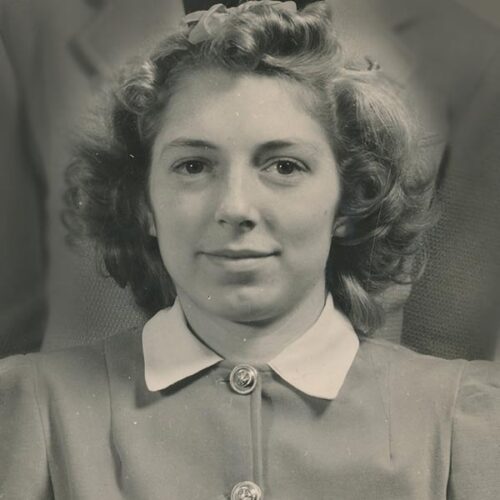
Class of 1941: Coined the space term ‘black hole’
A native of Grand Rapids, Michigan, Ann Elizabeth Ewing was born March 11, 1921. At Ripon College, she majored in chemistry and physics. She worked on the College Days newspaper and Crimson yearbook, serving as editor her senior year. She went on to become a renowned science journalist — for Science News, a publication of the Society for Science and the Public, from the late 1940s to the late 1960s; and then as a freelance reporter for medical trade newspapers.
She did graduate work in chemistry at the University of Chicago before joining the Navy in 1942, during World War II. She achieved the rank of lieutenant and served overseas as a Navy journalist until 1946.
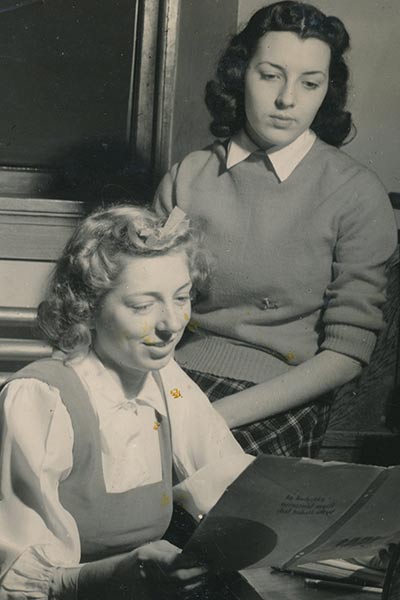
Ann Ewing, editor, and Joyce Winans, associate editor, both of the Class of 1941, discuss the upcoming edition of Crimson.
For many years, she was a senior science writer for the International Medical News Group, then she worked as a freelance writer. Her specialties included astronomy, physics and medicine. She is believed to be the first person to use the term “black hole” in space terminology in an article “Black Holes in Space” published in 1964. This received renewed recognition when the first-ever photographic image of a black hole was released April 10, 2019.
A black hole is described as “a region of space from which nothing, not even light, can escape. Despite the name, they are not empty but instead consist of a huge amount of matter packed densely into a small area, giving it an immense gravitational pull.”
In 1972, she became one of the first female journalists admitted to the National Press Club, and in 1976 she was named a lifetime member of the National Association of Science Writers. She held a pilot’s license and enjoyed flying small planes as a hobby. She also was active with civil rights and veterans groups.
She died July 24, 2010, at age 89. She is buried in Arlington National Cemetery.