Lori Stich
Posted September 28, 2026


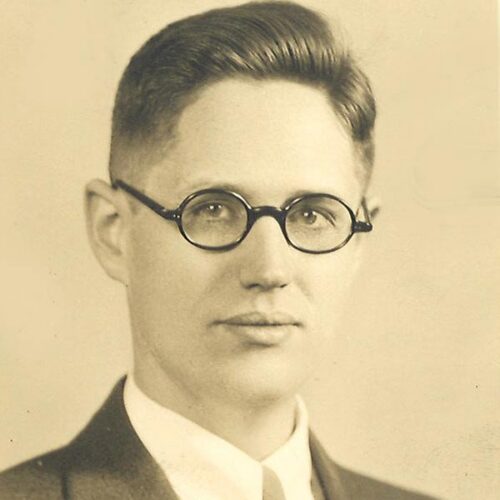
Class of 1923: Freedom of the Press
Distinguished journalist and fiercely passionate First Amendment advocate Curtis MacDougall was one of the nation’s most distinguished teachers of journalism, primarily at the Medill School of Journalism at Northwestern University.
He was born Feb. 11, 1903, in Fond du Lac, Wisconsin. At age 15, he was offered a position to write the column “High School Notes” for the local Fond du Lac Commonwealth-Reporter newspaper.
At Ripon, he majored in English and participated in College Days student newspaper, Alpha Phi Omega, plays and musical activities, forensics and debate. His debate partner his first year was future movie actor Spencer Tracy, Class of 1924, and another debate colleague was future education philosopher Theodore Brameld, Class of 1926. They all remained lifelong friends.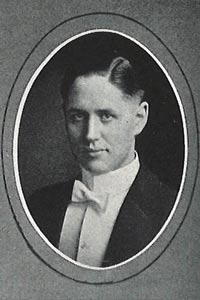
MacDougall received his master’s degree from Northwestern University in 1926 and his doctorate in sociology from the University of Wisconsin in 1933. MacDougall taught journalism at Lehigh University in Pennsylvania in 1927 and then worked as a reporter or editor at the Two Rivers (Wisconsin) Chronicle, United Press, St. Louis Star-Times, Chicago Sun and Evanston Daily News. From 1939 to 1942, MacDougall was state supervisor of the Illinois Writers Project.
He joined the faculty of the Medill School of Journalism at Northwestern University in 1942 and remained until retiring in 1971. Known as Dr. Mac to his students, he became one of America’s leading journalism experts and educators. He was apologetically blunt, remaining outspoken on his beliefs, political and otherwise, based on high principles and strong opinions.
He said he was motivated by “a passionate belief in Jeffersonian democracy which means the Bill of Rights, chiefly freedom of the press and absolutely no censorship or suppression of anything.” He said this also involves a responsibility for the public to be well-informed. “You can produce the 100-percent perfect news medium, but if there are only nincompoops to read it, democracy is still in danger,” he said.
An active figure in progressive politics, MacDougall ran for political office three times. While he was unsuccessful, he said his main motivation to run was to gain a platform for expressing his views.
He wrote more than a dozen books as well as articles and speeches influencing journalism education. “Interpretive Reporting” went through eight editions before his death and is considered the definitive text on journalism, a bestseller in the field and regarded by many as the “reporter’s Bible.”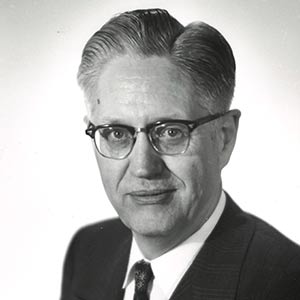
Others include “Hoaxes” (1941); “Understanding Public Opinion” (1953); “Gideon’s Army” (1965-66), a three-volume history of the Progressive Party movement of the late 1940s; and “Superstition and the Press” (1983).
He was working on the ninth edition of “Interpretive Reporting” at the time of his death.
Ripon College presented him with a Distinguished Alumni Citation in 1951 and the Medal of Merit in 1985. “I’ve done a lot of things and had a lot of experiences in my life. Intellectually, mentally, I don’t feel any older than when I was a freshman at Ripon,” he said.
He died Nov. 10, 1985, at the age of 82.