Lori Stich
Posted September 28, 2026


Class of 1913: ‘Discovery of the Elements’
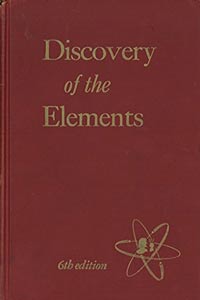
The classic chemistry book “Discovery of the Elements” (1933), by Mary Elvira Weeks, went on to be published in seven editions and multiple languages over the course of the next 35 years. It has been praised as the “first connected narrative of how scientists unraveled the mysteries of matter” and a “classic of chemistry.”
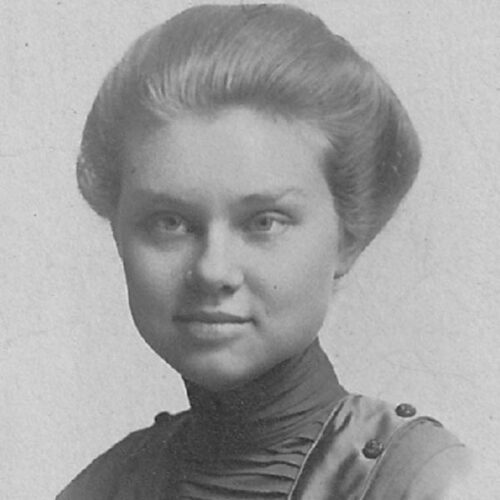
 Weeks was born April 10, 1892, on a farm near Lyons, Wisconsin, and was a graduate of Oshkosh High School. At Ripon College, she majored in chemistry and participated in Y.W.C.A. all four years and was inducted into Phi Beta Kappa.
She received her master’s degree in 1914 from the University of Wisconsin-Madison. After teaching at the high school level and working as an analyst in industrial laboratories for seven years, she took a position in 1921 as an instructor teaching quantitative analysis at the University of Kansas. She was the school’s first female faculty member. When she completed her Ph.D. there in 1927, she was the first female to receive a Ph.D. in chemistry from the school. She stayed for 22 years, teaching and doing laboratory research in physical and analytical chemistry.
“Discovery of the Elements” began with more than 21 articles in the Journal of Chemical Education. The series proved so popular that they were collected into book form in 1933. Through its seven editions, it became one of the most read chemistry books in the world.
It was a history of chemistry around the theme of the discovery of 94 elements between 1524 and 1964 and the human stories of the chemists behind those discoveries. It was lavishly illustrated with photos collected by a colleague and later Weeks, herself.
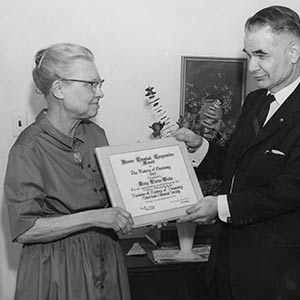
Mary Elvira Weeks receives the Dexter Award for Outstanding Achievement in the History of Chemistry in 1967.
In 1944, she combined her love of science, languages and history by becoming a scientific researcher at Kresge-Hooker Science Library, Wayne State University, in Detroit, for 10 years. She became head of the translation department and focused on translating scientific, technical and medical articles into German, French, Spanish, Italian, Swedish, Danish, Norwegian, Russian and Portuguese.
She co-wrote “A History of the American Chemical Society — Seventy-five Eventful Years,” published in 1952, with Charles Albert Browne.
After retiring from Wayne State in 1954, she worked as a scientific editor and translator. In 1967, she won the Dexter Award for Outstanding Achievement in the History of Chemistry from the American Chemical Society.
She lived in Detroit until her death on June 20, 1975, at age 83.