Lori Stich
Posted September 28, 2026


Class of 1973: Landscaping with the eye of an artist
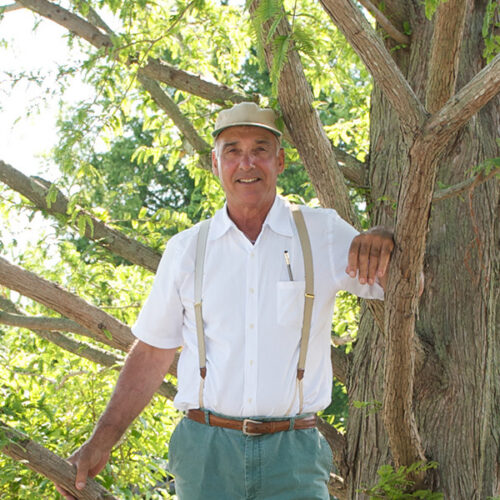
For nearly half a century, Charlie Marder and Kathleen Foran Marder, both of the Class of 1975, have offered personal artistry in landscaping and in garden shop selections around the northeast United States.
He was born April 25, 1953. At Ripon, he studied art.
Charlie Marder is a garden designer, horticulturist and plant collection curator, and Kathleen contributes expertise on rare and unusual plant materials. Their business, Marders, in Bridgehampton, Long Island, is renowned as one of the few companies that can successfully move giant trees, up to 100 feet tall; for Charlie Marder’s unique and instinctive landscaping designs; and offerings of giant and specialty trees, rare and exotic flowers, and unusual garden objects.
Charles says their success is directly tied to their liberal arts training at Ripon, where both were art majors. “It was a point of view we largely learned from Erv (Erwin) Breithaupt (professor of art from 1962-1983),” Charlie says. “How to proceed with whatever I wanted to do. It is the same process I use to do garden and landscape design as when I was doing assemblages from found objects on a multimedia at Ripon.”
With a lifelong interest in the natural world and his art training, “nursery and landscape work was where my formal education and my informal education collided. It was a coalition that amplified the process of doing things.”
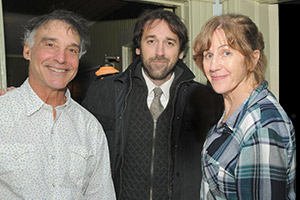
Charlie Marder, Class of 1975, left, Silas Marder, Class of 2000, and Kathleen Foran Marder, Class of 1975
Charlie and Kathleen married soon after graduation from Ripon and moved to Charlie’s hometown of Springs, Long Island. The landscaping business was started in 1976 with the goal of creating gardens that reflect homeowners’ tastes and lifestyles, emphasize the character of the local environment, and provide an alternative to “cookie cutter” landscapes, Marder says.
Using a hydraulic tree mover for one job opened up a whole new avenue for him. He says he used his problem-solving skills gleaned from his liberal arts education and creative process to develop a revolutionary new way of transplanting trees that produced a high survival rate, even for mature trees.
He soon became one of the pre-eminent experts in the nation on transplanting giant trees. He has moved trees for New York City’s Central Park, the Museum of Modern Art and Botanical Gardens, as private plant collections.
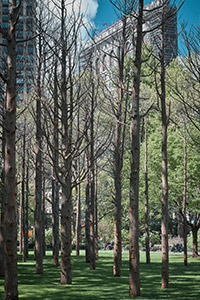
“Ghost Forest” in New York City’s Central Park in 2021
He and his team worked on a large-scale project with artist Maya Lin, who also designed the Vietnam memorial in Washington, D.C. Her “Ghost Forest” was a massive public art installation that ran in New York for six months in 2021. The art installation in Madison Square Park represented a ghost forest with 49 dead, 40-50-foot Atlantic white cedars to emphasize the devastating impact of rising sea levels and a statement addressing climate change.
Another inspiration was renowned artist Alfonso Ossorio, who built an arboretum of hundreds of rare and unusual trees and plants on his 64-acre East Hampton estate. “There’s a whole category of plants that are collectible,” Marder says. “I learned about the inside world of plant collecting, and insight not bought in formal horticultural experience.”
One of the Marders’ sons, Silas, Ripon College class of 2000, says clients are drawn to Marders because of his parents’ intuitive approach to visualizing landscapes and gardens. Going with the feel of a project and an artistic vision instead of using standard designs differentiates their work, Silas says.
Charlie acknowledges that he approaches his designs with the eye of an artist. The landscape is approached as a living canvas, integrating landscape, emotion and feeling, and integrating transformational thinking introduced by post-impressionism from Paul Cezanne and cubism by Pablo Picasso and Georges Braque.
“Landscaping is storytelling,” Charlie says, “The clients, the land and the architecture are all woven together. I want it to be articulate about the inhabitants of the property, creating drama, sensation in conjunction with the architecture.
“Every aspect of a landscape is considered, including the history. Driveways tell a special moving story, like a short film introducing the garden in controlled clips. When and where you see or hide the house, introducing a long glimpse of the water which later unfolds further into the garden. Upon leaving the property, the driveway is your last memory, another moving picture.”
While landscaping and plants present an aesthetic appeal, Marder says their impact goes far beyond that to a spiritual level. “Plants give you personal space. Clients connect to the trees and plants and are affected by them. Trees provide people with special peace and well-being.”