Lori Stich
Posted September 28, 2026


Class of 1937: Righteous Among the Nations
Stanley Nowinski was the son of Polish Catholic immigrants and grew up on a farm near Ripon, but his service during World War II and his humanitarianism led to recognition on the world stage for his assistance to displaced Jews after the war.
He was born Oct. 23, 1911. At Ripon College, he majored in German, history and economics, with a minor in education, and he participated in debate. He later taught German at the College. He was drafted into the military in 1941. He was one of the seven surviving sons in the family who all served during the war, including Peter Nowinski, Class of 1945.
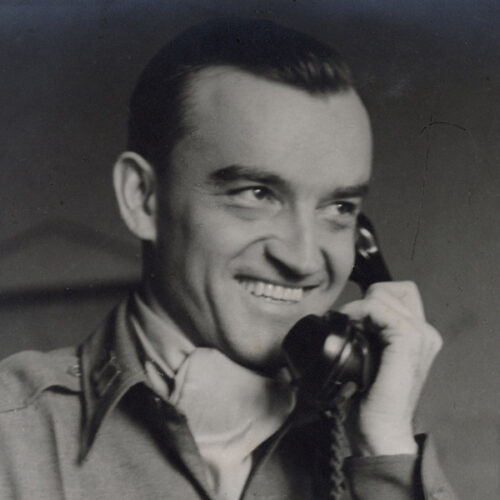
Stanley Nowinski during his service years. Photo courtesy of the Wisconsin Veterans Museum
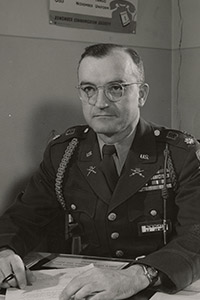
As an officer in the Rainbow Division, 42nd Infantry, of the U.S. Army in Europe, Nowinski was one of the liberators of the infamous Dachau Nazi concentration camp. After V-E Day in May 1945, he was assigned as the Displaced Persons Control Officer in Salzburg, Austria. He was charged with collecting, feeding, clothing and housing displaced people, then repatriating them to their home countries. Many Jewish survivors from Eastern Europe feared going back and claimed they were Italians, with the ultimate goal of going to Palestine (modern-day Israel) instead.
Against orders and at the risk of jeopardizing his military career, Nowinski worked with Bricha, an underground Jewish survivor organization, to help about 40,000 Polish and German Jews with altered identification papers pass through the Italian reception center to Palestine.
“It wasn’t exactly illegal,” Nowinski told The Journal Times newspaper of Racine, Wisconsin, in 1973. “If they said they were Italians, my job was to get them back to Italy. I just wouldn’t look too carefully at their papers.”
He also authorized Abba Weinstein (later Abba Gefen), a Bricha leader, to form the Committee for Assistance to Jewish Refugees and worked to get more food to refugees.
Nowinski later served in the Korean War and retired from the Army in 1961 as a lieutenant colonel. He then taught German and American history at Union Grove High School in Wisconsin for six years.
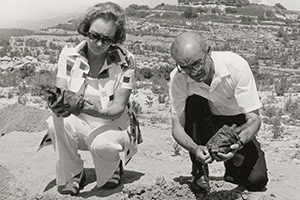
In 1973, Stanley Nowinski and his wife, Hazel, plant trees in a national forest in Israel where he was recognized as Righteous Among the Nations. Photo courtesy of the Wisconsin Veterans Museum
In 1973, Nowinski and his wife, Hazel, were invited to Israel where he received the Remembrance Medal and the Righteous Among the Nations designation for non-Jews who risked their lives to save Jews during the Holocaust. At Yad Vashem, a national shrine housing a mourning light for those who didn’t survive the Holocaust, the Nowinskis relighted the light and visited the archives, a rare honor.
He also was a charter member of the Holocaust Memorial Foundation in Illinois.
Nowinski is cited as a hero in several Jewish history books. In Gefen’s “Unholy Alliance,” it states: “Nowinski expected no rewards from us. He considered it his plain and simple duty, as a human being, to do his utmost for the survivors of the Holocaust on their difficult way to a secure haven.
“At least, when he reads these words of mine in his sanctuary of retirement in Wisconsin, he will know that Jews have a peerless historical memory and that they remember with overflowing love and grateful affection all who succored them in their trying hours.
“And his fellow Americans, who may note my homage, too, will be proud of him and thank him for investing the American people with the merit of his magnificent services. …”
Nowinski died July 6, 1993, at age 81.