Lori Stich
Posted September 28, 2026


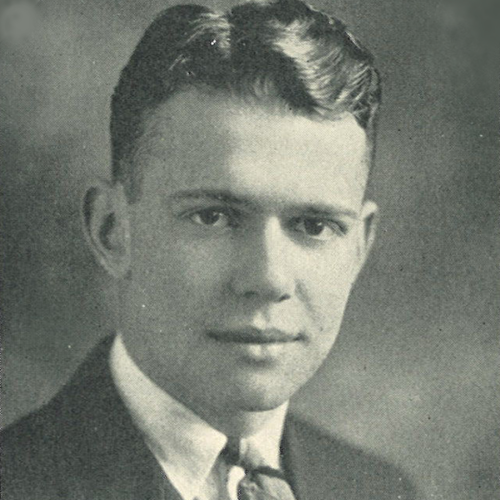
Class of 1926: Educational philosopher
Theodore Burghard Hurt Brameld was a philosopher and visionary educator who developed the Social Reconstructionism theory of education and impacted educational thought and practice through the latter part of the 20th century.
He was born Jan. 20, 1904, in Neillsville, Wisconsin. He majored in English and speech communication at Ripon and participated in Phi Delta Theta and Alpha Phi Omega, debate and oratorical, and was editor-in-chief of the Crimson. After graduation, he stayed at Ripon for two years in administration as the first editor of the Ripon Alumnus publication and the first alumni secretary.
He then completed his doctorate in philosophy at the University of Chicago in 1931 with the dissertation “A Philosophic Approach to Communism” which was published in 1933.
The ideas of Marxism and Social Reconstructionism were his focus. This philosophy promotes political and social transformation through education and asserts that the task of democratic education is to develop worthy goals through “social consensus.” He believed that schools should take the lead in social and cultural change.
“Our aim is always to build a ‘group mind’ that expresses the social consensus of the majority,” he wrote in his 1956 book, “Toward a Reconstructed Philosophy of Education.”
His other books include “Minority Problems in Public Schools” (1945), “Ends and Means in Education: A Midcentury Appraisal” (1950), “Patterns of Educational Philosophy: A Democratic Interpretation” (1950), “Philosophies of Education in Cultural Perspective” (1955), “Cultural Foundations of Education: An Interdisciplinary Exploration” (1957), “The Remaking of a Culture: Life and Education in Puerto Rico” (1959), “Education as Power” (1965), “The Use of Explosive Ideas in Education: Culture, Class, and Evolution” (1965), “Japan: Culture, Education, and Change in Two Communities” (1968), “The Climactic Decades” (1970, “The Teacher As World Citizen: A Scenario of the 21st Century” (1976) and “Tourism as Cultural Learning” (1977).
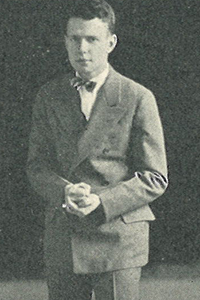
Theodore Brameld emotes with the Ripon College debate team.
As an educator, he taught at various places of higher learning, including Long Island University (1931-1935), Adelphi College in New York (1935-1939), the University of Minnesota (1939-1947), New York University (1947-1958), and Boston University (1958-1969), and some time at the University of Puerto Rico.
He also lectured widely around the world, including time as an instructor with World Campus Afloat, a study-abroad program now called Semester at Sea.
He continued to be involved in community change initiatives. He was listed as a noteworthy educator by Marquis Who’s Who; was vice president American Education Fellowship, 1942-1953; secretary treasurer of the Philosophy of Education Society, 1941-1947, and president, 1947-1948; American delegate to the International Conference New Education Fellowship, Australia, 1946; visiting specialist in Japan and Korea for the Department of State Department, 1962-1963; a Fulbright research scholar in Japan, 1964-1965; member of the executive board council for Study of Mankind, 1969-1987; and senior fellow East-West Center, 1971-1972.
He once said, “Teaching seems to me beyond doubt the greatest of the professions.”
He died Oct. 18, 1987, at age 83.