Lori Stich
Posted September 28, 2026


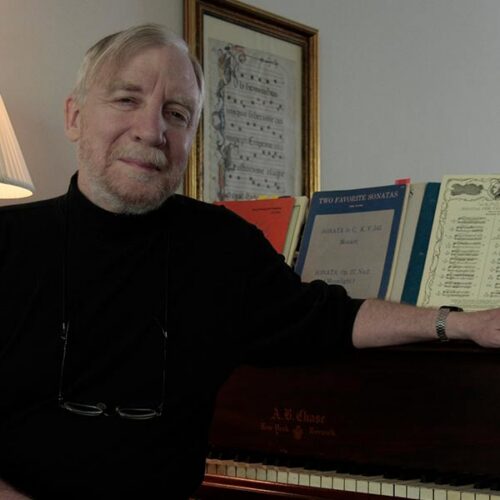
Class of 1962: NASA, Artificial intelligence
Peter Bock has been seeking out possibilities for the future throughout his career as an international expert on artificial intelligence (AI) and cognitive science.
He was born in June 1941 and grew up in Chicago. At Ripon, he studied physics and drama. He also enjoyed a three-year collaboration with future jazz superstar artist Al Jarreau, Class of 1962; Thomas “Duffy” Ashley-Farrand, Class of 1962; and Bock’s future wife, Donna Oberholtzer, Class of 1963. For three years, they sang together around the region in their ensemble The Indigos.
After completing his graduate studies at Purdue University in 1965, Bock joined NASA in its early days and eventually became the director of software development for the Apollo Program. He managed the development of software for the earth and lunar orbital missions.
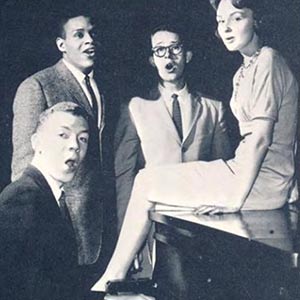
Singers P. Bock, A. Jarreau, D. Ferrand and D. Oberholzer
Following the first successful manned Lunar-landing mission in 1969, Bock joined the engineering faculty full time at The George Washington University in Washington, D.C.
He began his research career in artificial intelligence (AI) and cognitive science and remained on the computer science faculty for 40 years.
In addition to teaching, he pioneered the development of collective learning systems theory, an adaptive statistical-learning paradigm for artificial intelligence. This is the theoretical basis of the AI software engine known as ALISA (Adaptive Learning Image and Signal Analysis), used by prominent firms and institutions around the world. He also has designed and conducted complex industrial research projects in a wide variety of domains.
His books include “The Emergence of Artificial Cognition: An Introduction to Collective Learning,” published in 1993 by World Scientific Publishing Company; and “Getting it Right: Research Methods for Science and Engineering,” published by Academic Press in 2001. He also has published research papers extensively and has served as chair of the International Advisory Board, an innovative tripartite undergraduate curriculum and modern campus for the new all-English University of Information Science and Technology in Ohrid, Macedonia.
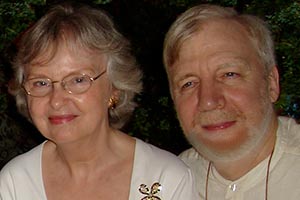
Donna Oberholtzer, Class of 1963, and Peter Bock, Class of 1962.
Bock’s expertise crosses multiple disciplines, from computer science to cognitive science, anthropology, developmental psychology and the humanities. These varied areas are necessary to understand how the human brain operates, he said.
“It’s a big challenge,” he said. “The DNA you inherited from your folks contains enough information to build your body, but comes nowhere close to the amount of information you need to fill your brain and live life. You begin with an empty computer for a brain. The rest is learned.”
Humans record symbolically, Bock said. “We write, paint and record our experiences in many different ways and pass them on, so our offspring don’t have to learn everything from scratch. That progress is critically important.”
From 1990 on, he worked to extend the cognitive capabilities of ALISA and develop practical applications of ALISA’ statistical learning methods and sophisticated clustering algorithms to natural language analysis and synthesis. His long-term research objective was the design and implementation of an artificially intelligent being whose cognitive capabilities are on a par with those of human beings.