Lori Stich
Posted September 28, 2026


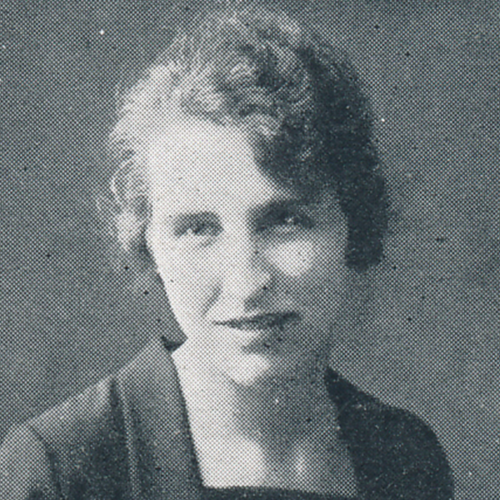
Class of 1922: Developing atomic weapons, health physics
Elda Emma Anderson did critical work on the development of the atomic bomb that would be used to end World War II, then worked the rest of her life to help to develop a new scientific field with the goal to better understand and minimize harm from radiation.
She was born Oct. 5, 1899, in Green Lake, Wisconsin. At Ripon, she studied physics and mathematics and participated in YWCA, Latin Club, Women’s League and Math Club, and she served as an assistant in physics and a Department Fellow in mathematics. She received her master’s degree and Ph.D. in physics from the University of Wisconsin.
Anderson was dean of physics, chemistry and mathematics from 1924 to 1927 at Estherville Junior College in Iowa, where she also taught chemistry, and principal of the high school in Menasha, Wisconsin, from 1927-1929. In 1929 she became a professor in the new physics department of Milwaukee-Downer College, which later was merged with Lawrence University in Appleton, Wisconsin. She became head of the department in 1934.
She had been researching spectroscopy, the study of the absorption and emission of light and other radiation, and was recruited in late 1941 to work in the Office of Scientific Research and Development at Princeton University. She began work on the Manhattan Project, the code name for the U.S. government’s secret project to develop an atomic bomb to help speed the end of World War II.
She was transferred to Los Alamos Scientific Laboratory in New Mexico in 1943 where a team of scientists worked closely together and in secret to develop an atomic bomb quickly before Germany was able to do so. She said the three years at Los Alamos were the most hectic of her life, working up to 18 hours a day every day except for Christmas.
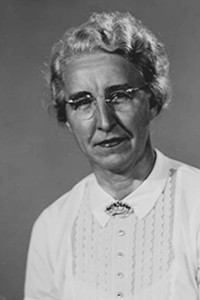 She produced the lab’s first pure sample of uranium-235, a key component to the development of the bomb. She was present at the Trinity Event, the explosion of the first atomic bomb in the New Mexico desert, July 16, 1945. Intent on the flash of light and billows of smoke, she’d forgotten sound would follow and was jolted when the sound of the explosion reached her a few minutes later.
Anderson returned to teaching in 1947, but her research in atomic physics made her aware of the harm radiation could do to living things. A new field of science, health physics, had been established to study and prevent the effects of radiation on human health. In 1949, Anderson became the first chief of education for the Health Physics Division at Oak Ridge National Laboratory in Tennessee.
She published “Manual of Radiological Protection for Civil Defense” in 1950, helped establish a master’s degree program in health physics at Vanderbilt University in Nashville, Tennessee, and organized international courses in Sweden, Belgium and India through the World Health Organization.
She held several positions with the Health Physics Society, established in 1955, and served as the secretary and then chairman of the American Board of Health Physics, a professional certifying agency created by the Health Physics Society.
The Elda E. Anderson Award is given annually by the Health Physics Society to an outstanding young health physicist.
She died April 17, 1961, of leukemia, a blood cell cancer, and breast cancer, which may have been exacerbated by her work in radiation. She was 61.