Lori Stich
Posted September 28, 2026


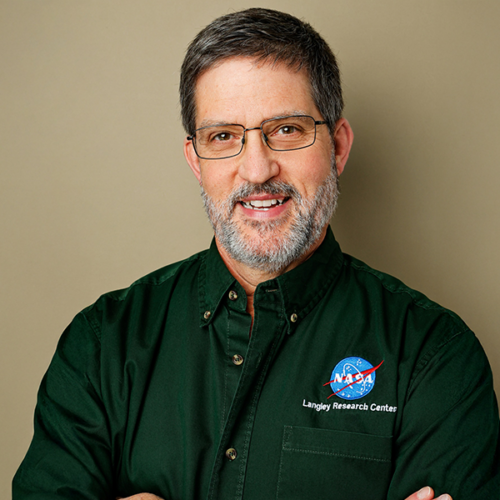
Class of 1983: Aerospace engineer
An early interest in aeronautics and space led to a lifetime of service with the National Aeronautics and Space Administration for Larry Huebner.
He was born Lawrence David Huebner Aug. 27, 1961, in Green Bay, Wisconsin. “Growing up during the Apollo lunar landing missions, it was a dream of mine to be part of the organization that made that happen: NASA. It was when I took my first physics course in high school that I began to understand the miracles of both atmospheric and space flight,” he said.
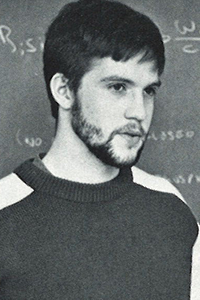
Huebner during his Senior Seminar in physics at Ripon College
At Ripon, he double majored in physics and mathematics and participated in WRPN Radio, Symphonic Wind Ensemble, Jazz Ensemble, Orchestra, Beta Sigma Pi fraternity, Sigma Pi Sigma (physics honor society) and Phi Beta Kappa. He also was the student representative for the Alumni Board of Directors and the Curriculum Committee.
He received his Master of Science in aeronautical engineering from George Washington University.
Huebner began his career at the BDM Corporation, performing analytical and experimental research in high-speed missile concepts. He joined NASA in 1987 as a support service contractor, performing experimental and computational research in hypersonic aerodynamics.
After becoming a civil servant, he worked at NASA Langley Research Center for 14 years, primarily in hypersonic aerodynamics, hypersonic airbreathing propulsion, and scramjet ground and flight testing, including the role of scramjet lead for the first successful scramjet-powered vehicle flight test: X-43A Flight 2.
Starting in 2004, his work at Marshall Space Flight Center in Huntsville, Alabama, initially was in support of Ares I rocket development (including the flight demonstration of Ares I-X), then focused on space technology.
He recently retired as a mission manager within NASA’s Technology Demonstration Missions Program Office. “As mission manager, I provided programmatic and technical oversight for two projects in TDM’s portfolio,” Huebner said. “One of these projects is addressing technologies that could be used to build roads and landing pads on the moon known as Mason. The other project is developing a sun-independent source of electrical power for future lunar and Martian campaigns known as Fission Surface Power.”
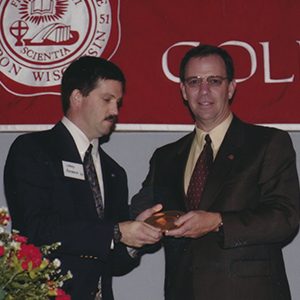
Larry Huebner receives his Ripon College Distinguished Alumni Citation from then-President David Joyce.
He has served as the leader for the supersonic combustion ramjet, or scramjet, propulsion team, which lead to the development of the X-43A, an unpiloted, hydrogen-fueled hypersonic research aircraft; aeronautics team lead for the Ares I and Ares V rockets; and technical lead for OSAM-2, the On-orbit Servicing, Assembly, and Manufacturing-2 demonstrator.
He has been directly involved with 25 formal technical publications, 60 referenceable conference papers and presentations, and 22 other publications. His honors include the NASA Exceptional Service Medal, the NASA Engineering and Safety Center Director’s Award, and the Joint Army Navy NASA Air Force (JANNAF) Lifetime Achievement Award from JANNAF’s Airbreathing Propulsion Subcommittee, as well as Ripon’s Distinguished Alumni Citation presented to him in 2003.
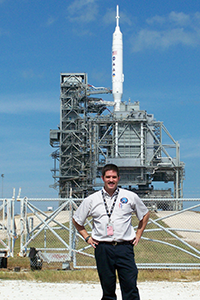
Huebner stands in front of the Ares I-X vehicle at Kennedy Space Center two days before launch.
In addition to giving him “a hunger for taking on challenges,” Huebner said, his Ripon College education has developed his abilities to comprehend, think and communicate. “This has served me extremely well throughout my career from when I was designing hardware and acquiring unique data … to the more managerial and leadership roles which I recently performed.”
His brother, Bill Huebner, Class of 1980, retired after more than 30 years of service at NASA’s Johnson Space Center in Houston, Texas.
Huebner said that “the work I performed was important because NASA is developing technology capabilities that don’t exist now yet will be needed if (hopefully when) there is a permanent human presence off the Earth. There is something about doing the ‘never done before’ things that is central to what NASA does that continues to drive my interest, curiosity, and determination to succeed.”