Lori Stich
Posted September 28, 2026


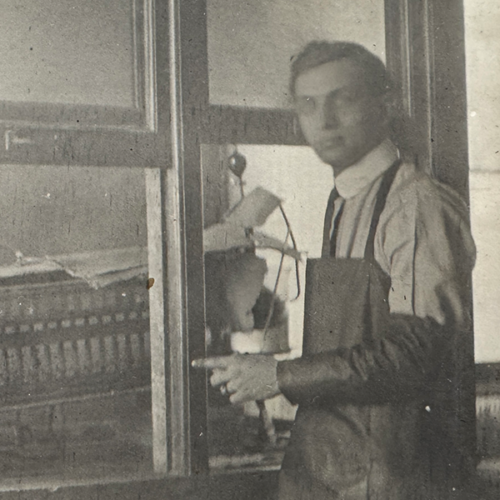
Class of 1909: Telephone technology
In the early years of the 20th century, Otto Julius Zobel was an electrical engineer who helped advance early telephone technology at American Telephone and Telegraph Co. (AT&T) and Bell Laboratories.
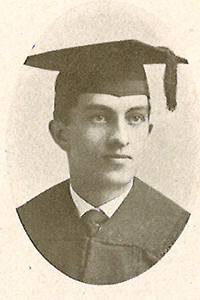 He was born Oct. 20, 1887, in the family home at 603 Watson St. in Ripon. At Ripon College, he majored in physics and served as a fellow in physics. His thesis was on “Theoretical and experimental treatment of electrical condensers.” He was known both for his academics and his participation in musical groups. His yearbook stated: “His science makes you sit up and notice things, his mathematics is as self-evident as short division, and his music holds you gasping for very lack of description.”
He received a Distinguished Alumni Citation from Ripon in 1947.
Several of his siblings also attended Ripon, and the entire family was involved with music.
He received a master’s degree in physics from the University of Wisconsin in 1910 and his Ph.D. in 1914, with the dissertation topic “Thermal Conduction and Radiation.” During those years, he also was a physics instructor at the University of Wisconsin from 1910 through 1915 and co-wrote a book on geophysical thermodynamics in 1914.
From 1915 to 1916, he taught physics at the University of Minnesota. He then joined
the engineering department of the American Telephone and Telegraph Co. (AT&T), first in New Jersey and later in New York, and the Department of Development and Research in 1919. He worked on transmission techniques and the design of electric wave filters now known as the image method. He later transferred to Bell Telephone Laboratories, a research organization created jointly by AT&T and Western Electric.
He held numerous patents in electrical communication networks and was the inventor of the m-derived (or m-type) filter in 1920, the constant-resistance filter and the Zobel Network.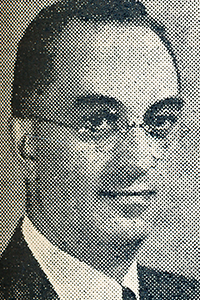
His revolutionary filter design contributed to significant commercial advances for AT&T in frequency-division multiplex (FDM) telephone transmissions.
He also did work in audio sound, the formulation of air-wave filters and sound transmissions. He retired from Bell Telephone in 1952.
Although more modern filter designs are used today, Zobel’s work remains the basis of filter theory.
He died Jan. 11, 1970, at age 82.