Lori Stich
Posted September 28, 2026


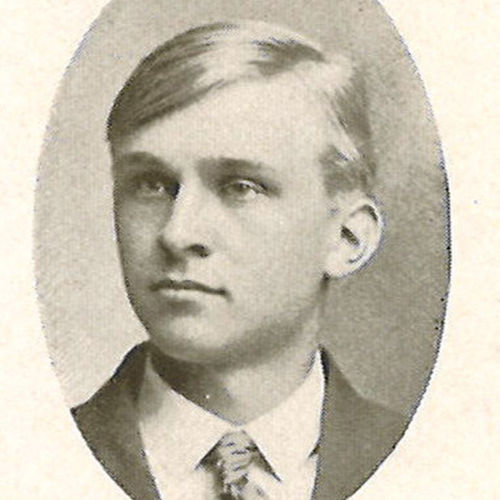
Class of 1910: Audiogram
Physicist Raymond Lester “R.L.” Wegel was born July 13, 1888, in Fond du Lac, Wisconsin, and his work would help establish the new specialty profession of audiology.
At Ripon College, he majored in physics, participated in Glee Club, Conservatory Orchestra, Mathematics Club, Science Club and Band. He was also an instructor in physics during his senior year.
The Crimson yearbook praised him: “ ‘Ray’ specializes in the mathematics department – and cheers lustily from the sidelines of every athletics event. ‘Ray’ works quietly — behind the scenes of Ripon’s pantomime — but the influence of his example is here — there — everywhere”; and “He could distinguish and divide a hair twixt south and southwest side.”
During his studies at the University of Wisconsin-Madison, he specialized in theoretical physics.
 From 1912 to 1913, he worked as a physicist in the laboratory of Thomas A. Edison in Orange, New Jersey. In 1914, he joined the engineering department of Western Electric Company in New York City and remained there until his retirement in 1949.
He worked mainly in the areas of telephone transmitters and receivers as well as hearing and speech. His early work involved practical rationalizations of some of the physical problems of telephone receivers and transmitters, relays, mechanical filters, and other transmission apparatus.
During World War I and World War II, Wegel was engaged in antisubmarine projects.
For AT&T, the study of hearing/speech processes and hearing loss were important to telephone communication. To measure hearing loss, Wegel, of AT&T’s engineering wing Western Electric Company, and colleague Harvey Fletcher, of the research wing at Bell Telephone Laboratories, collaborated. They designed and developed the first commercial audiometer in the United States, the Western Electric Model 1-A, in 1922, as well as one of the most often used and valued diagnostic tools in audiology, the audiogram.
These helped lead to the establishment of audiology as a specialty practice to serve those with hearing loss.
In physiological physics, Wegel worked on theories of the mechanism of hearing and of the voice. He held numerous patents and published extensively, including “A Theory of Vibration of the Larynx” in 1928.
He died in March 1973 at age 84.