Lori Stich
Posted September 28, 2026


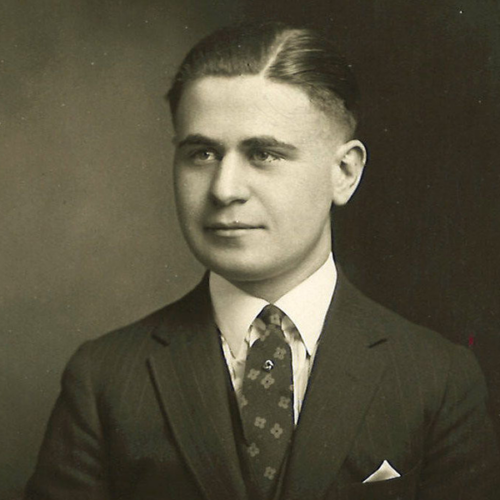
1924: Artificial larynx
Robert R. Riesz had a distinguished career in industrial physics at Bell Telephone Laboratories, helping to develop and patenting the Bell 2A artificial larynx in 1929. He then passed on his passion through education.
He was born Feb. 9, 1903, in New York, New York. At Ripon, he majored in physics and mathematics, was a student fellow and student assistant in physics and an assistant in mathematics, and participated in Phi Kappa Pi (Merriman), College Days and Crimson yearbook.
He earned a master’s degree in physics from the University of Wisconsin-Madison in 1925 and did graduate work in physics at Columbia University, New York, and the University of Michigan.
For more than 35 years, he was a member of the technical staff of Bell Laboratories, Murray Hill, N.J., and a licensed engineer, working in the field of acoustics and more particularly the study of the physical principles involved in human speech and hearing and the design of communications equipment.
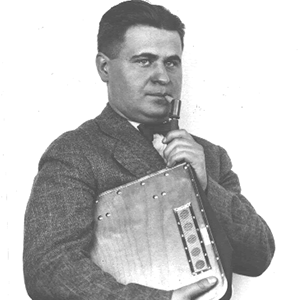
Robert Reisz demonstrates how one with normal vocal equipment can use the artificial larynx with the aid of bellows.
From 1926 to 1962, he worked on vibratory mechanics and did research in the physics of speech and hearing. He developed an artificial larynx, which “restored the power of speech” to those who had had their larynx removed. He also researched visible speech to allow deaf people to “hear” by reading visible patterns produced by spoken words.
Prior to and during World War II, he worked on developing speech processing systems such as the Voder and Vocoder, and later worked in human factors engineering as applied to communication systems. He held 22 U.S. patents and published numerous scientific papers.
In 1962, he retired from Bell Laboratories to become an associate professor of physics at Union College, a private liberal arts school in Barbourville, Kentucky, and the first college founded in the Kentucky mountains.
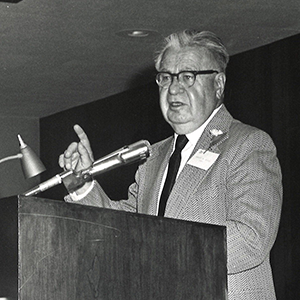
Robert Reisz speaks at Ripon College.
Riesz eventually became chairman of the mathematics and physics department. Although his salary was 75 percent less in this position, he relished the fact that “the other rewards have been great. To see a boy from the hills develop into what I think is a potential mathematical genius is something to behold. And I have seen it happen,” he wrote to Ripon.
He received Ripon’s Distinguished Alumni Citation in 1947. In 1968, he was elected to Phi Beta Kappa by the Ripon College chapter of the honorary scholastic society.
“Ripon gave me the conviction that there was no intellectual problem that I was not capable of solving — not a bad objective of the liberal arts college,” he said.
He died Dec. 10, 1974, at age 71.