Lori Stich
Posted September 28, 2026


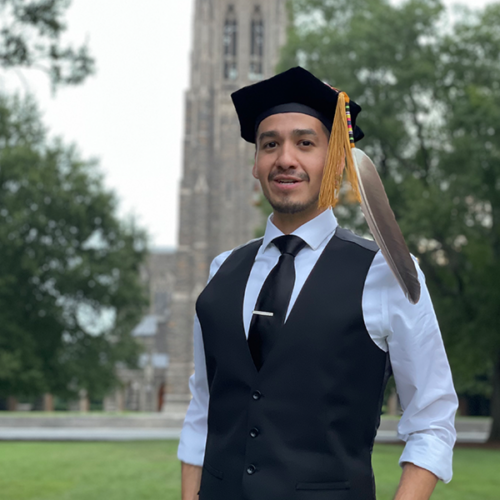
Class of 2015: Indigenous knowledge in science
As a tribal member of the Lac du Flambeau Band of Lake Superior Chippewa Indians, Raymond Lance Allen said there are Indigenous traditions and ways of knowledge production that typically are overlooked or even “stolen” by Western science. He wants his work in science to change that perception.
He was born Feb. 21, 1993, and came to Ripon from Lac du Flambeau, Wisconsin. At Ripon, he majored in chemistry-biology and participated in a wide variety of campus offerings. He was a member of EGOR (Environmental Group of Ripon), Martial Arts Club and Student Senate; worked on campus as a tutor, biology lab assistant and student athletic trainer; was a McNair Scholar and student representative to the Alumni Board; and did off-campus study at the University of St. Andrew’s in Scotland and the University of Chicago.
He received his Ph.D. in biology from Duke University.
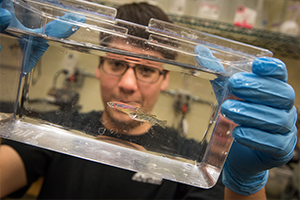
Working with zebrafish larval development at Ripon College
He currently is a development biologist and a postdoctoral research fellow at the University of Wisconsin-Madison’s Center for Limnology at Trout Lake Station in Boulder Junction, Wisconsin. “My current research is on parasites of freshwater fishes in northern Wisconsin in collaboration with the Lac du Flambeau Fish Hatchery,” Allen said.
In March 2026, Allen was named a recipient of the inaugural National Geographic American Keystones Grants for his work with ogaa (walleye; Sander vitreus), assessing walleye health through microbiome and social science work to sustain the cultural and nutritional kinship of the Ojibwe people.
His first-author paper, “A 100-Year Bloom of Indigenous Limnology and Reconnection to Land through Field Stations,” was published in 2026 in the American Indian Culture and Research Journal (AICRJ) for its special Issue on Indigenous Resurgence.
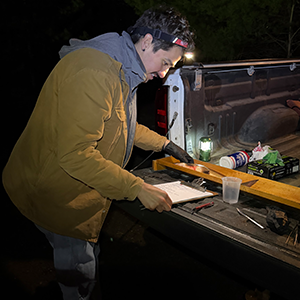 Allen also served as an elected council member for the Lac du Flambeau Band of Lake Superior Chippewa Indians from 2022-2024.
Centering research on Indigenous-produced knowledge in science continues to be a focus. “A lot of Western science is based on western European ideas,” Allen said. As an Indigenous American scientist wanting to decolonize the field, he says Indigenous peoples have “a profound understanding and relationships with non-human relatives.”
He says one of the most frustrating things for him is that Western science tends to ignore Native scientific knowledge until Western science “discovers” what Indigenous people already knew. An example of this is “traditional ecological knowledge,” which recently but selectively has been recognized as important in select Western science circles. “My tribal community has taught me to always bring my Native perspective to everything I do and to be proud of it,” Allen said.
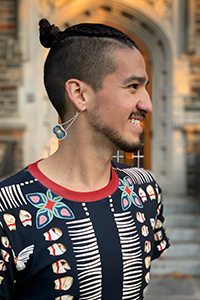 He said the broad education and experiences he received at Ripon also contributes. “I very much describe myself as an inter/transdisciplinary researcher where my focus is the natural sciences, but I’ve slowly and intentionally accumulated training and knowledge broadly which I use to both enhance and critique my and other folks’ work in the field,” Allen said. “The reason I was even aware to ‘think outside the field’ was because of classes I took at Ripon.
“It’s because of my liberal arts education that I can successfully think outside the box and find my niche and support to do the work.”
He said Ripon is special. “You find Ripon and folks associated with it everywhere! I currently work at a center which is often described as the birthplace of Limnology, the study of freshwater lakes and rivers in North America, but I was recently doing some reading and came across this quote: ‘One can argue convincingly that (Edward Asahel) Birge was not the first limnologist in Wisconsin. In 1883 C. D. Marsh, who was four years Birge’s junior in age, became a Professor of Natural Science at Ripon College, just seven miles from Green Lake.’ (Limnology in North America; David G. Frey; Page 19). Ripon’s influence goes far and wide!”