Lori Stich
Posted September 28, 2026


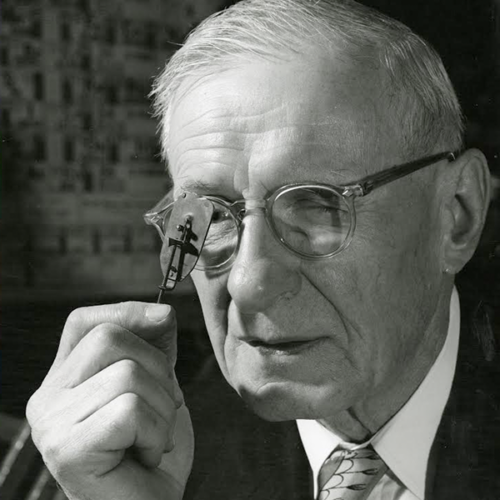
Class of 1910: Over the moon
The impact crater Meggers, on the far side of the moon, was named in honor of physicist William Frederick Meggers, a pioneer in the field of spectroscopy, by the International Astronomical Union.
Meggers was born July 13, 1888, and grew up on a farm in Clintonville, Wisconsin. He earned a scholarship to Ripon College, served as a research assistant in physics, and received his degree in physics in 1910. He earned a master’s degree from the University of Wisconsin in 1916 and his Ph.D. in physics, mathematics and astronomy from Johns Hopkins University in 1917.
 In 1914, he joined the National Bureau of Standards in Washington, D.C., and was made head of the Spectroscopy Section in 1920. He remained in that position until retiring in 1958.
Meggers’ work advanced the disciplines of spectroscopy, photography, astrophysics and atomic and nuclear physics. He pioneered new techniques in spectrochemistry and established standards of spectrography measurement that are accepted around the world.
Optica, formerly the Optical Society of America, says: “Some of his important projects covered the measuring of standard wavelengths with interferometers, photographing spectra beyond visible red, demonstration of the use of red-sensitized emulsions for photography from airplanes, and other pioneer spectrochemical analyses, measuring many indexes of refraction of the atmosphere.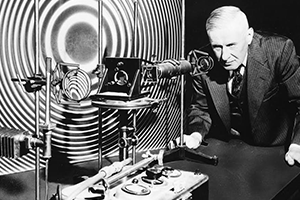
“As an active member of the International Astronomical Union’s Commission on Standard wavelengths, Meggers was the main contributor to secondary standards of wavelength from an iron arc measured relative to the primary standard (red radiation from cadmium). He provided an improved primary standard (Meggers Mercury 198 Lamp) and superior secondary standards emitted by an electrodeless lamp containing thorium iodide.
“A paper on ‘Practical Spectrographic Analysis’ published in 1922 is generally credited with reviving interest in chemical spectroscopy. He spent much of his career improving not only standard wavelengths but also descriptions of atomic and ionic spectra. His work led to the calibration of intensity and spectral number as well as the energy levels responsible for each spectral line.”
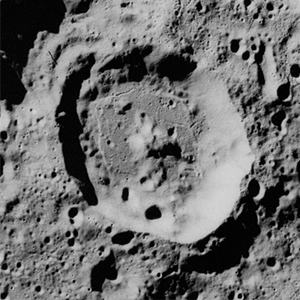
The impact crater Meggers on the far side of the moon was named for Meggers by the International Astronomical Union (IAU) “in honor of his achievement as a physicist in spectroscopic research.”
Other honors include the Frederic Ives Medal from the Optical Society of America in 1947; the C.E.K. Mees Medal, the U. S. Department of Commerce’s Exceptional Service Gold Medal; membership in the National Academy of Science; and the William F. Meggers Award for outstanding work in spectroscopy, named in his honor by the Optical Society of America.
Upon winning the Franklin Institute’s Eliot Cresson Medal in 1953, he told Ripon: “It is gratifying to know that my efforts to add to the sum of human knowledge are appreciated by fellow citizens as well as by scientists. If I have done anything noteworthy, due credit must be given to Ripon College, where forty-five years ago Professor William Harley Barber inspired me to major in physics.”
He received a Distinguished Alumni Citation from Ripon in 1947 and an honorary degree in 1951.
Meggers and his wife, Edith, donated their coin and stamp collections to the American Institute of Physics in 1965 to establish a biennial award program for the improvement of physics teaching at the high school level. The William F. and Edith R. Meggers Project Award has been presented since 1994.
One of Megger’s children was his daughter, Betty J. Meggers, a noted archaeologist at the Smithsonian Institution in Washington, D.C., who specialized in South American pre-Columbian archaeology.
William F. Meggers died Nov. 19, 1966, at the age of 78.