Jonathan Muraskas
Posted November 4, 2026



Class of 2011: International public health
“As with many things, my choice of career was influenced in large part by serendipity,” said Dr. Kylie Ainslie.
Her specific research interests were honed early at Ripon College, and she took advantage of fortuitous opportunities that led to an international career influencing public health policy.
Ainslie was born in 1989 in Atlanta, Georgia. She grew up visiting family in Wisconsin. Her father, William Ainslie, is a member of the Ripon College Class of 1979, and she was awarded Ripon’s Harry W. Knop Jr. ’42 Endowed Scholarship. Therefore, choosing to come to Ripon College “felt like a natural fit,” she said.
At Ripon, Ainslie obtained a double major in biology and mathematics and a minor in chemistry. She was named to the Phi Beta Kappa Honor Society and Beta Beta Beta Biological Society. While at Ripon, she also studied abroad for a semester in Budapest, Hungary, which inspired her to move abroad permanently.
While pursuing a Ph.D. in biostatistics from Emory University, she worked with the supervisor on a project that involved modelling the spread of influenza and the impact of vaccination on that spread. “I loved it,” she said.
After graduating from Emory in 2018, she moved to London to work as a research associate in infectious disease dynamics at Imperial College London. Ainslie specifically developed individual-based mathematical models of susceptibility, to determine how repeated exposures to pathogens (e.g., influenza) or interventions (e.g., vaccines) influence an individual’s susceptibility to subsequent infections.
When the COVID-19 pandemic began in early 2020, “my influenza work quickly shifted to modelling the spread of COVID-19 and providing support for UK government policy decisions,” Ainslie said.
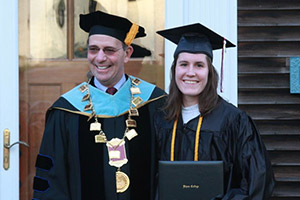 After the emergence of SARS-CoV-2, she became a member of the Imperial COVID-19 Response Team and led the analytics for the Real-time Assessment of Community Transmission (REACT) study. The REACT study provided crucial information to the UK government on the COVID-19 epidemiological situation and was instrumental in shaping public health strategies and supporting the pandemic response across the UK.
In late 2020, Ainslie moved to Amsterdam, The Netherlands, to become a senior researcher in infectious disease modelling at The Dutch National Institute for Public Health and the Environment. She led the modelling work to inform the Dutch COVID-19 vaccine rollout by using mathematical models of infectious disease transmission to determine the impact of vaccination strategies on disease spread.
Ainslie is also an honorary assistant professor at the University of Hong Kong School of Public Health where her work focuses on determining the real-world protection provided by vaccines against respiratory diseases, such as COVID-19 and influenza.
In late 2025, Ainslie was appointed as Modelling for Policy Lead, a joint position at the University of Melbourne and The Peter Doherty Institute for Infection and Immunity in Melbourne, Australia.
Her research interests include epidemiology, infectious disease modelling, vaccine effectiveness and biostatistics, and her research work has been widely published.
“Ripon taught me how to think,” Ainslie said. “Despite becoming increasingly specialized through graduate degrees and postdoctoral research, it’s never been more obvious to me that innovation comes from diverse perspectives and broad experiences. Liberal arts gave me that broad foundation and appreciation for seemingly nontraditional ideas.
Liberal arts — and Ripon — cast the building blocks that I’ve built the rest of my career
on.”