Jonathan Muraskas
Posted November 4, 2026


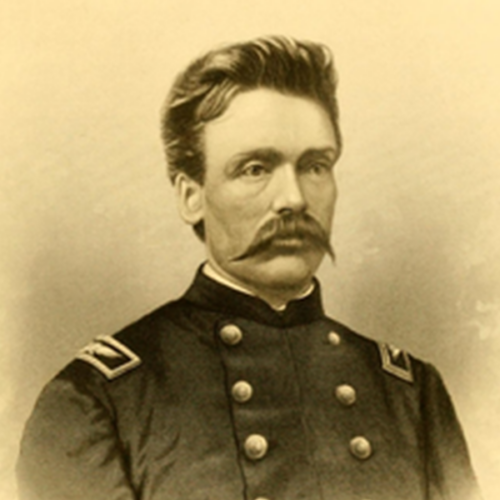
1850s: Abolitionist, Civil War officer
Oscar Hugh La Grange, known as Hugh, was an American lawyer and abolitionist activist. He served as a Union Army officer in the American Civil War and received an honorary brevet to brigadier general.
He was born April 3, 1837, in Fulton, New York, and moved with his family to the Ripon area in 1845. He was an ardent abolitionist, and in 1855, as a teenager, he fought in the anti-slavery crusade “Bleeding Kansas.”
By teaching and farming, La Grange was able to finance studies at Brockway College (now Ripon College) and later at the University of Wisconsin at Madison.
From August through October 1860, La Grange took an active role in what was known in Wisconsin as the Booth War.
Public dissent against a U.S. Supreme Court decision was rising. In 1854, La Grange and Brockway librarian Edward Daniels had helped Milwaukee abolitionist newspaper editor Sherman Miller Booth free a fugitive slave, Joshua Glover, from jail and enabled him to escape to Canada.
Booth claimed the Fugitive Slave Act was unconstitutional, and he spent the next five years in and out of jail over the controversy. The Wisconsin Supreme Court ruled in his favor, but the U.S. Supreme Court ruled against Booth and Wisconsin in March 1859. Booth was rearrested and jailed in Milwaukee.
Brockway librarian Edward Daniels and La Grange lead a group that fooled the jail guards, broke Booth out of jail and took him back to the Ripon area. This put La Grange under order for arrest and he went into hiding for some weeks. Alvan Bovay, a Ripon College founder, loaned him $20 in assistance.
La Grange, Bovay and Daniels all were indicted over the incident, but later were pardoned by President Abraham Lincoln.
After the outbreak of the Civil War in 1861, La Grange enlisted in the Union Army and rose through the ranks from company captain to become a brigadier general. He was one of the first to enlist in the “Ripon Rifles” (Co. B of the 4th Infantry) and was unanimously elected company captain.
When the 1st Regiment of Wisconsin Cavalry was organized a few months later, he signed and joined the new regiment as a major. He was promoted to lieutenant colonel in 1862 at age 25, and later as colonel.
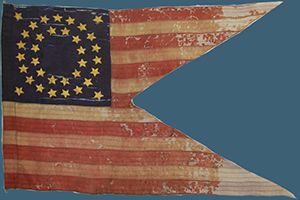
Guidon, 1st Wisconsin Cavalry Regiment
Photo courtesy of the Wisconsin Veterans Museum in Madison
In 1863, La Grange became a brigade commander in the Army of the Cumberland. He later took part in the Battle of Chickamauga, Battle of Rocky Face Ridge and Battle of West Point.
One of his men later recalled that La Grange’s “personal courage was a marked trait, amounting almost to rashness. He did not say ‘go’ but always ‘come.’ He enjoyed nothing more than a headlong cavalry charge, when he was in the front rank.” Another said, “He looked like a berserker, and was full of daring. His fixed rule was to let no man get deeper into the battle than himself.”
La Grange was mustered out of the volunteers as a colonel on July 19, 1865. In 1866, he was nominated for appointment to the grade of brevet brigadier general of volunteers by President Andrew Johnson, and this was confirmed by the United States Senate March 12, 1866.
After the war, La Grange studied law and was admitted to the bar. He moved to California and held various positions, including superintendent of the U.S. Mint in San Francisco, district attorney for Alameda and presidential elector-at-large from California. He relocated to New York City in the 1890s and worked in law and was fire commissioner of New York City.
“General La Grange’s life was exceptionally busy and useful,” a former colleague wrote. “As a soldier, he was among the bravest of the brave, withal of kind and tender heart. He was an able commander, keeping his men always at the front and always on the go, yet constantly looking after their physical welfare. He was an eloquent speaker, an honest public official, a patriotic citizen. His old comrades who fought by his side will never forget Hugh La Grange, chivalrie, impetuous, noble and true.”
La Grange died Jan. 5, 1915, at age 77.