Caestecker Gallery to Present “Mixed Signals (New Paintings +),” New Work by Derrick Buisch
Posted September 3, 2026


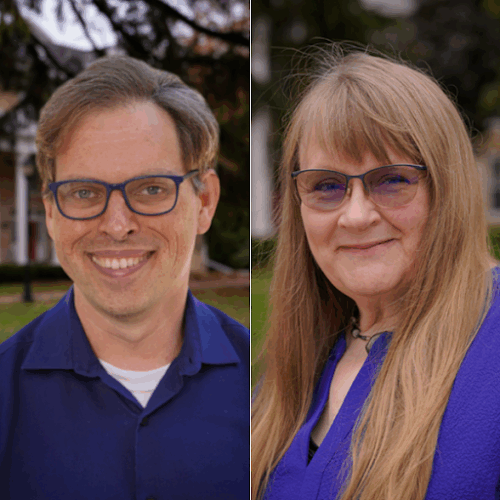
Two Ripon College professors have published a bibliographic essay in Choice, the journal of the American Library Association. Travis Nygard, art, and Ursula Dalinghaus, anthropology, contributed “The Financial Value of Art: How the World of Visual Art Intersects with the World of Money” to the April 2025 issue.
This collaboration began when the editors of Choice approached Nygard about writing a bibliographic essay on the financial value of art. Both he and Dalinghaus have been interested in the cultural significance of money for many years, and it seemed natural to collaborate on this topic.
“For us, it means a great deal to have this essay published in Choice, as that is one of the most important journals for librarians,” Nygard and Dalinghaus said. “Our thinking will thus be used to develop collections in libraries across the country, and it will inform how students learn about this topic for decades.”
Nygard said it was a big process to look at so many books published on the topic of money and art, but also incredibly satisfying. He also said it was a great multidisciplinary collaboration between the art department and the sociology and anthropology department.
“It was fascinating to learn to think about art from the perspective of anthropology, which has intellectual traditions that are so different from the world of fine art,” Nygard said.
Dalinghaus’ research focuses on the cultural and economic value of money, including cash. She is particularly interested in the questions of “When and in what contexts does art become a kind of ‘money substitute’ and when and why is art seen as diametrically opposed to money?”
“As an anthropologist who studies money, I found it particularly fascinating to think about questions of fungibility (interchangeability) in relation to art and money,” Dalinghaus said.
Nygard has taught a course focused on the business of art, covering topics like art made from money and the financial value of individual artworks. In addition to his work at Ripon College, he is an accredited member of the International Society of Appraisers.
Dalinghaus said she looks forward to teaching the essay in her spring 2026 course on the anthropology of money (ANT-ECO 317) and creating an experiential learning opportunity for students to explore the essay’s themes.
“I love to do collaborations, and this was a great way for each of us to learn about each other’s intellectual interests,” Dalinghaus said. “We hope to continue to work together in the future, and will do a joint presentation this fall at the SECAC art conference (formerly the Southeastern College Art Conference) in Cincinnati.”
According to Nygard and Dalinghaus, the core argument of the essay emphasizes that there is not just one way that art and money relate, but many.
“Artworks sell for many different prices, in different contexts,” Nygard and Dalinghaus said. “Art can be made of money. Art can also become money in certain contexts. Our essay helps readers to think about this interplay between art and money’s forms and values. For anyone interested in learning about how some artworks sell for millions of dollars, while others are worth almost nothing, this will be a great read. We think that people will enjoy it.”