Lori Stich Obluda
Posted September 28, 2026


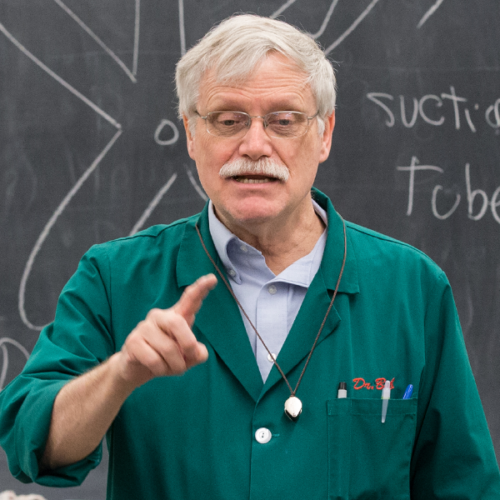
Rotifer expert
Robert Lee Wallace, professor of biology from 1977 until retiring in 2019, has inspired generations of Ripon College students and brought to the world leading research on rotifers: microscopic, aquatic invertebrates.
Wallace was born Oct. 12, 1948, in Queens, New York. He received his Bachelor of Science from the University of Rhode Island in 1970 and his Ph.D. in aquatic ecology and invertebrate zoology from Dartmouth College in 1975. After completing his dissertation, he taught one term at Dartmouth and then moved to the University of Washington (Seattle) where he was supported by the National Science Foundation on a two-year, postdoctoral research grant.
Known to generations of Ripon students affectionately as “Dr. Bob,” Wallace has dedicated most of his career to the study of the phylum Rotifera, typically called rotifers, which are about the size of the dot over a printed letter “i” in a standard font.
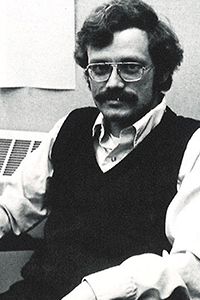 “Rotifers may be found anywhere liquid water is present for even a few days,” Wallace said.” While some inhabit near-shore marine waters, most are commonly found in inland waters, including lakes, ponds, streams, ephemeral desert basins, ditches, glacial meltwaters, and the thin film of water in soils and on plant leaves.”
As an international expert, Wallace has a productive publication record in professional journals, chapters of books, encyclopedias, laboratory manuals, and study guides. Many of these include collaborations with Ripon College students and alumni. His research was awarded dozens of research grants, including several from the National Science Foundation.
He is a frequent presenter at national and international conferences and symposia and participates in collaborative, multi-year international studies. He also has presented two weeklong series of lectures to graduate students at The National Autonomous University of Mexico in Mexico City.
Simultaneously with his tenure at Ripon, he also has served as an adjunct professor of biology at the University of Texas at El Paso as an outside examiner for masters and Ph.D. candidates.
Wallace notes that to be fascinated by biology is to be fascinated by all life, both extant and extinct. “I can’t understand why anyone wouldn’t be,” he said. And for him, teaching “is an important part of that fascination; it is both fulfilling and inspiring. I like the idea that I’m launching intellectual arrows into the future. As part of that, I want to leave my students with the thought ‘Do what you can, with what you have, where you are.’ — T. Roosevelt. That’s a saying I have added to my syllabi for years, and one I try to live by.”

Bob Wallace in the lab with Hilary Smith Uyhelji, Class of 2007, now a principal research geneticist with the Federal Aviation Administration in Oklahoma City, Oklahoma.
He has received the May Bumby Severy Award five times and was honored with the Underkofler Excellence in Undergraduate Teaching Award twice: 2001 and 2015. In 2005, he was named the inaugural Patricia and Philip McCullough 1969 Professor in Biology.
Along with a colleague, Dr. Hendrik Segers, Wallace named a genus of rotifer: Conochilopsis. Then, in 2008, a species of rotifer was identified and named after him: Floscularia wallacei.
Since retiring, Wallace has continued his research and publishes on rotifers and environmental issues, collaborates with students on summer research projects and has been active with the Green Lake Association to improve water quality on Green Lake near Ripon.
In 2025, he received a lifetime achievement award — Medalha Prof. Lejeune de Oliveira — from the Associação Brasileira de Limnologia (Brazilian Association of Limnologists) for his research on rotifers.