Lori Stich Obluda
Posted September 28, 2026


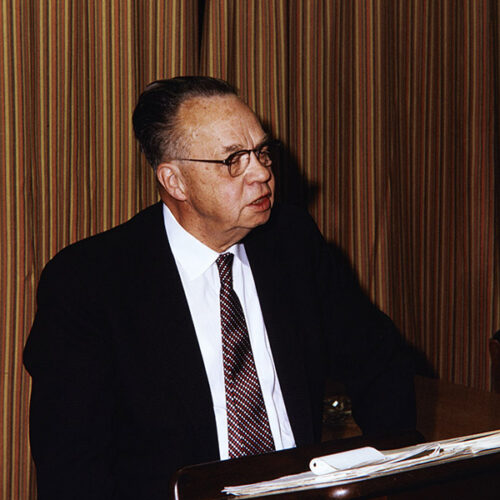
Carl P. Russell speaks at Grand Canyon National Park.
Class of 1916: National Park Service
Carl Parcher Russell was a historian, ecologist and administrator. He served with the National Park Service for 34 years, from 1923 until his retirement in 1957, and is credited as one of the architects of the National Park Service and with developing most of the museums in the national parks.
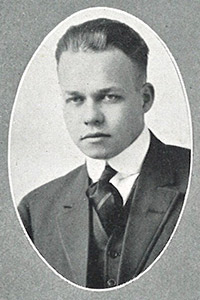
He was born Jan. 18, 1894, in Fall River, Wisconsin. At Ripon College, he majored in biology, was his class treasurer and participated in the Crimson yearbook, for which he was in charge of art; Social Committee; Woodside Club; and band, in which he played cornet.
He received a master’s degree in cytology in 1917 and a Ph.D. in ecology in 1931 from the University of Michigan.
 After serving as a lieutenant of infantry during World War I and teaching high school in Reno, Nevada, Russell began a 34-year tenure with the National Park Service. He was chief naturalist in Yosemite National Park from 1923 to 1929, leaving to become head of all the western parks’ museums, chief of the Museum Division and chief of the Wildlife Division of the National Park Service.
From 1930-1934, he worked in Yellowstone Park in summers and in winters with museum programs in Southwestern National Monument, in Arizona and New Mexico.
He returned to Yosemite as superintendent from 1947-1952, then left to write a four-volume history of the North American fur trade under a Guggenheim Memorial Foundation Fellowship.
Often referring to Ripon College as “that well-loved old campus,” Russell stayed in frequent contact throughout his life. Ripon College presented him with a Distinguished Alumni Citation in 1947 and an honorary doctor of laws in 1951.
When Russell retired from the Park Service in 1957, he was presented with the Interior Department’s Distinguished Service Award. He continued to write until his death. In addition to numerous papers published in scientific, historical and recreational journals, and massive research notes left behind, his major works include the books “One Hundred Years in Yosemite: The Story of a Great Park and Its Friends,” “Firearms, Traps, and Tools of the Mountain Men,” “Guns on the Early Frontiers: From Colonial Times to the Years of the Western Fur Trade” and “Rifles and Riflemen at the Battle of King’s Mountain.”
His consuming interest was the western frontier from exploration through the national expansion, about 1804 through 1843, and he was an acclaimed scholar in the fur trade, firearms, frontier life and early trappers and traders.
He died June 19, 1967, at age 73.