Lori Stich Obluda
Posted September 28, 2026


English
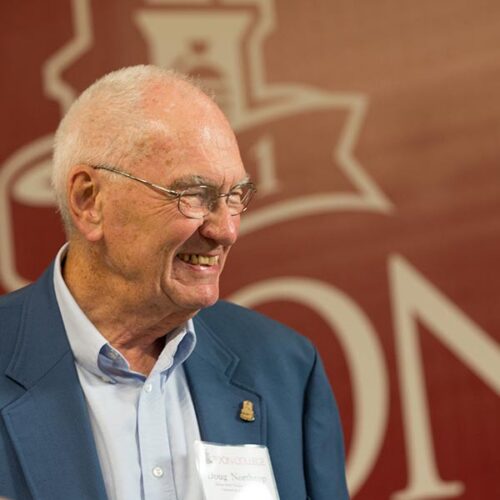
Why study English? “Because it’s fun. There is no finer explanation,” said Douglas A. Northrop, whose half-century of service to Ripon College from 1960-2012 encompassed being a professor and chair of the department in the Department of English, vice president and dean of faculty, and myriad other roles.
“Literature gives insights into human nature. It transports you to places you couldn’t go otherwise. And it allows you to exercise your moral judgement without the intervention of self-interest,” he said.
He was born in April 1935 and was a native of Rochester, New York. He earned his bachelor’s degree in English from Wesleyan University and his master’s degree and Ph.D. in English from the University of Chicago, where he specialized in literature of the English Renaissance.
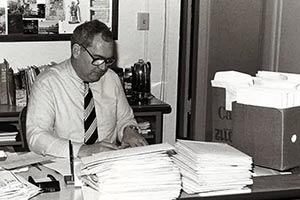 When he first came to Ripon, he taught English for 17 years, advancing to the role of Helen Swift Nielson Professor of Cultural Studies and chair of the department. He taught in Ripon’s summer Upward Bound program and in 1974 was the program’s academic coordinator.
He then served in administration as vice president and dean of faculty for another 17 years, from 1977-1993. Northrop helped make the campus a more culturally conscious place, g a sexual harassment task force in the early 1980s which set clear boundaries for inappropriate behaviors. He also supported the Fisk University/Ripon College program, a student exchange with a historically black university in Tennessee. As dean, Northrop was “instrumental in working with other deans in the Associated Colleges of the Midwest in strengthening off-campus study options – such as the student exchange program between Ripon and Ripon, England, — for students and faculty,” administrators said at the time.
“Two of the things I worked to achieve while Dean were increasing the appointment and development of women into tenured positions on the faculty,” Northrop said, “and shifting the direction of the educational program from teaching, which emphasized faculty, to learning, which emphasized students. We worked for less of a presentational program to a more interactive one.”
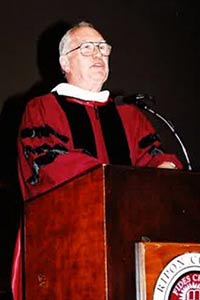 Then, eager to return to the classroom, he rounded out his Ripon career again teaching English. He retired in 2012.
Outside of Ripon, Northrop served as chair of the Wisconsin Humanities Committee in 1989-1990. During his tenure, the committee won an exemplary award from the National Endowment for the Humanities for its proposal for a program to study Native American literature, history and traditions.
He was a National Endowment for the Humanities Fellow in Residence at the University of Chicago in 1975-1976.
Ripon honored him with two teaching awards, the May Bumby Severy, Class of 1908, Award in 1966 and the Uhrig Foundation Award for Excellence in Teaching in 1971. He was presented with an honorary degree in 2001.
He and his wife, Lynn Post Northrop, jointly received Ripon’s Founders’ Day Award in 2011, and the Douglas Northrop Endowed Liberal Arts Scholarship was established in his name
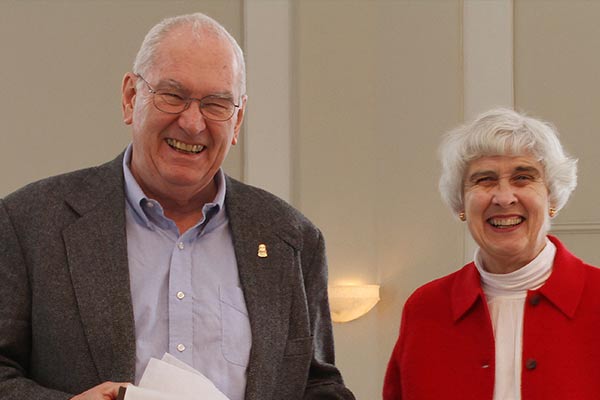 The couple were generous benefactors to the College, supporting Friends of the Arts and the Center for Politics and the People. Northrop also established the Lynn Post Northrop Endowed Fund for Women Speakers; and, after Lynn’s death in April 2014, the Lynn Post Northrop Memorial Concert Endowment.
A distant ancestor of Northrop’s was Ezra L. Northrup, one of the original founders of Ripon College.
In a reflection on the value of a liberal arts education, Northrop once wrote: “Perhaps something mysterious and wonderful did happen. Not every day nor in every class, but in the accumulation of experiences, a set of values, an extended appreciation, an enlarged understanding, a desire for learning and the ability to learn do emerge. A student gains a perspective on an individual, the society, humankind, and on the nature and purpose of education itself, and that perspective is what is so liberal about liberal education.”