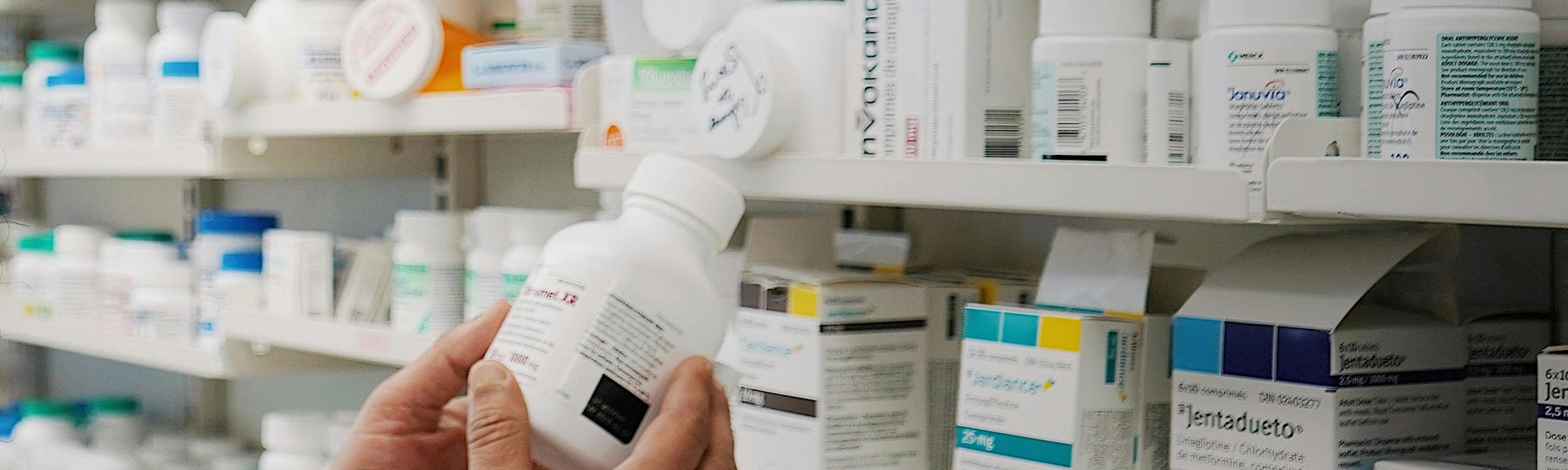
YOUR PRESCRIPTION FOR A FASTER PATH TO PHARM.D.
Pharmacists select the right medication and dosage, prepare and dispense treatments, advise patients, and monitor for harmful side effects. The path leads to a Doctor of Pharmacy (Pharm.D.) degree—at least two years of pre-professional study followed by four years of professional study—and Ripon’s advising and 3+3 affiliation help you build the foundation to get there.


WHAT PHARM.D. PROGRAMS ARE LOOKING FOR
Pharm.D. admission requirements are generally more extensive and detailed than medical school’s, and they differ markedly between programs—so it’s essential to confirm specifics with the schools you plan to apply to. Most programs evaluate:
- Completion of required pre-pharmacy coursework
- Quality of academic record
- Letters of recommendation
- A résumé
- A personal interview
BUILD THE RIGHT FOUNDATION*
Interested students should plan around a heavy science course load, balanced with math, English and social science. Your core coursework:
- Chemistry — 8-10 credits of inorganic chemistry (CHM 112, 211), 8-10 credits of organic chemistry (CHM 111, 214), plus Biochemistry (CHM 422)
- Biology — At least 8 credits, including general biology (BIO 123, 122), plus one additional course Zoology (BIO 216), Genetics (BIO 219), Botany (BIO 227), Animal Diversity (BIO 229), Microbiology (BIO 314), or Anatomy & Physiology (BIO 211-312)
- Physics — 8-10 credits of general physics (PHY 131, 152/172)
- Math — Calculus (MTH 201) and Statistics (MTH 120 or PSC 211)
- English — CTL 110
- Social Science — 4 credits (e.g., Sociology SOC 110 or Anthropology ANT 110)
- Humanities — 4 credits
Requirements vary markedly by institution—always confirm current prerequisites directly with the school of pharmacy you plan to apply to.

A FASTER PATH TO YOUR PHARM.D.
Ripon’s 3+3 affiliation with the Medical College of Wisconsin (MCW) School of Pharmacy lets you earn both a bachelor’s degree from Ripon and a Pharm.D. from MCW in just six years. Here’s how it works:
Apply during your first or second year at Ripon
Complete your major, the Catalyst Curriculum, and all prerequisite courses at Ripon by the end of your junior year
Begin pharmacy studies at MCW in your fourth year
Stay enrolled full-time each semester at Ripon, with a cumulative GPA of 3.0+
More on Prerequisites
- Two Advanced Biology courses (BIO 211, 219, 266, 300 with HPAC approval, 305, 312, 327, 329)
- Three General Chemistry courses (CHM 112, 211, 422)
- Two Organic Chemistry courses (CHM 111, 214)
- One Statistics course (MTH 120 or PSC 211)
- One Calculus course (MTH 201 or MTH 202)
- One Composition course (CTL 110)
- One Public Speaking course (COM 115)
- Four General Education courses (CTL 120, 210, 220, 300)

MORE PATHS, MORE POSSIBILITY
Ripon’s affiliation with Midwestern University opens the door even wider. Qualified students receive guaranteed interviews at the College of Pharmacy–Glendale (CPG) and College of Pharmacy–Downers Grove (CPDG).
Ask your HPAC advisor how to make the most of it.